
Last month, a production team for a mid-market electronics brand spent forty-eight hours trying to “fix” a three-second product reveal. The video, generated from a prompt-only video engine, featured a smartphone that appeared to breathe—its edges expanding and contracting like a lung. No amount of motion brush tweaking or “negative prompting” for stability solved the issue. The failure wasn’t in the motion model; it was in the source frame. The original image had soft, indistinct edges and lighting that didn’t logically map to a 3D space.
In the rush to adopt generative video, we have overlooked a fundamental truth of the medium: the motion engine is merely a puppet master. If the “puppet”—the source image—is structurally unsound, no amount of sophisticated animation can save the final render. Professional-grade AI video is not a product of the motion engine alone; it is a direct consequence of the spatial detail, lighting anchors, and composition choices made during the source image generation phase.
The Upstream Fallacy in Generative Workflows
There is a persistent myth among content teams that video-to-video or image-to-video models are corrective. The assumption is that the “AI magic” will fill in the gaps of a mediocre source asset. This is the “upstream fallacy.” In reality, the first frame acts as the genetic code for every subsequent millisecond of the sequence. If the source frame contains “mushy” pixels or ambiguous geometry, the motion model interprets that ambiguity as fluid matter.
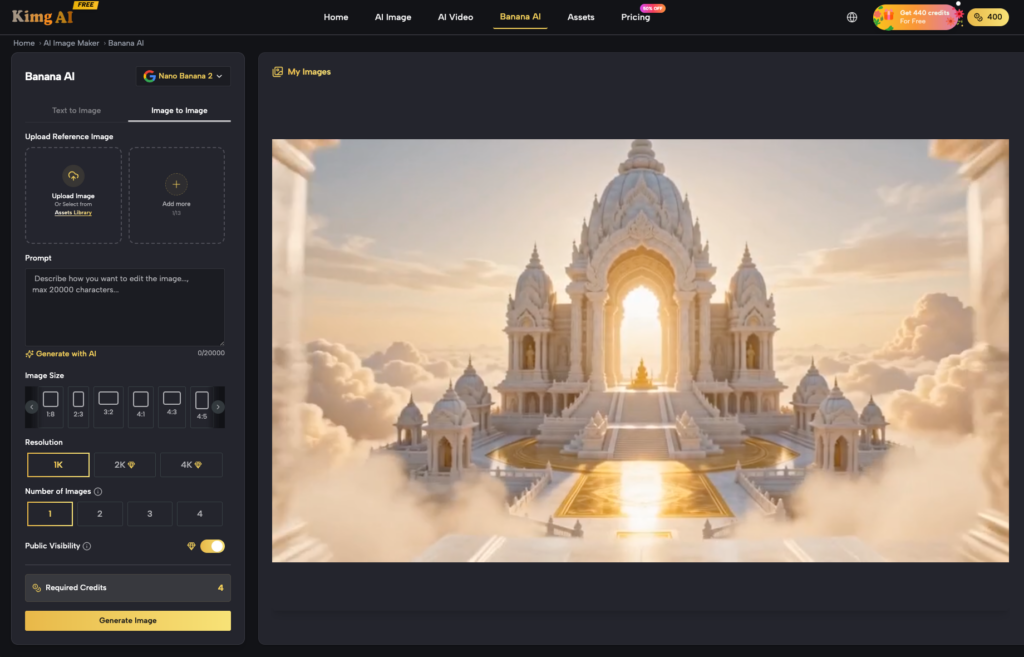
When you feed a high-end motion model like Kling or Veo an image with poor structural integrity, the model struggles to identify which pixels belong to the foreground and which belong to the background. This leads to the “melting” effect often seen in low-quality AI clips. For instance, using Banana AI to generate a master frame requires a shift in mindset: you aren’t just making a pretty picture; you are building a blueprint for physics. If the hands in your source image are already showing signs of anatomical confusion, the video model will exponentially increase those errors as it tries to calculate the motion of each joint.
Structural Integrity: How Kimg AI Prevents Temporal Warping
Temporal warping is the technical term for when objects in a video change shape or “pulse” inconsistently over time. This is almost always a failure of the source image’s edge definition. If a character’s shoulder fades into a soft-focus background without a clear luminance or depth transition, the motion model won’t know where the shoulder ends and the air begins.
When working within Banana AI, the goal should be to maximize compositional “anchors.” These are high-contrast areas and sharp lines that tell the downstream video model, “This is a solid boundary.” Product teams must treat the “Image to Image” phase as a hardening process. By refining a concept in Nano Banana first and then graduating it to a more robust model, you can ensure that the structural boundaries are locked. If you skip this and go straight to video, you are essentially asking the computer to guess the weight and density of your subjects, which it is notoriously bad at doing.
Beyond Resolution: Information Density in Kimg AI
We often conflate resolution with quality, but in the context of generative video, “information density” is the more relevant metric. You can have a 4K image that is semantically “thin”—meaning it lacks the micro-textures that allow a motion model to track surfaces. A smooth, featureless wall is harder for an AI to animate realistically than a brick wall because the brick wall provides thousands of “tracking points” for the algorithm to latch onto.
This is where Nano Banana AI becomes a critical part of the pipeline. It isn’t just about upscaling to a high pixel count; it’s about generating textures that survive the noise-reduction passes of video engines. When a video model processes a frame, it often applies a layer of “diffusion” to create smooth motion. If your source image doesn’t have enough “K-level” detail, the video engine will smooth it out until the result looks like a moving watercolor painting rather than a film. For launch assets that need to stand up to 4K displays or large-scale social placements, starting with a high-density frame is the only way to prevent the “SaaS-y,” overly-smooth look that characterizes amateur AI content.
Lighting as a Motion Anchor: A Technical Evaluation
Lighting is perhaps the most underrated factor in video stability. In traditional cinematography, lighting defines depth. In generative video, lighting defines the depth map. If your source image features flat, “global” lighting with no clear shadows, the motion model lacks the data required to calculate 3D parallax.
In our testing, source images with high-contrast, directional lighting—think Rembrandt lighting or strong rim lights—consistently produce more stable video than images with soft, even light. When using Nano Banana to refine an image, baking in these directional light sources guides the motion model’s understanding of physics. If there is a clear specular highlight on a metallic surface, the AI knows exactly how that light should shift as the camera moves. If the lighting is flat, the AI “pulses” the brightness of the entire object, creating a flickering effect that is nearly impossible to remove in post-production.
Determining the Edge of Possibility: What We Cannot Fix
It is important to reset expectations regarding what a perfect source frame can actually achieve. Even with the highest fidelity master frame from Banana AI, certain types of motion remain fundamentally broken in the current generation of tools.
First, complex fluid dynamics—such as water pouring into a glass or a splash—are still largely a coin toss. The source image can provide the “state” of the water, but the motion models often fail to respect the volume of the liquid, leading to water that simply vanishes or grows infinitely. Second, there is the uncertainty of “motion brushes.” While these tools allow for manual control, they often contradict the inherent perspective of the source frame. If you take a perfectly composed Nano Banana AI image and force a brush stroke that violates the 3D perspective of the lens, the model will prioritize the brush stroke over the image’s geometry, resulting in a distorted render. A perfect source frame is a prerequisite, but it is not a guarantee of a perfect render. We are still in a phase where manual curation and “re-rolling” are mandatory.
Integrating Kimg AI into a Professional Production Pipeline
For teams looking to build a repeatable asset pipeline, the workflow must be “source-first.” The temptation is to iterate on the video, but the efficiency is found in iterating on the image.
The most cost-effective sequence we have found involves three distinct stages:
- Conceptualization in Nano Banana: Use this for rapid-fire ideation. It’s about finding the right “vibe” and basic composition without worrying about pixel-perfect detail.
- Hardening in Banana AI: Once a concept is selected, move it into the more powerful model to “harden” the edges, fix anatomical errors, and establish the lighting anchors discussed earlier. This is where you commit to the “K-level” resolution.
- Motion Integration via Kimg AI: Only after the source frame is vetted for structural integrity should you move to the video tools. By vetting the frame first, you reduce credit waste significantly. A team that spends ten minutes perfecting a source frame will often get a usable video in two or three renders, whereas a “prompt-to-video” approach can take thirty or forty attempts to get a clip that doesn’t “melt.”
The future of generative media isn’t just about who has the fastest motion model. It’s about who understands the underlying architecture of the frame. As we move toward higher standards for AI-generated launch assets, the invisible ceiling of source image fidelity will become the defining boundary between “AI-looking” content and professional visual storytelling. To break through that ceiling, you have to stop thinking of the image as a static result and start seeing it as the engine for everything that follows.